Every morning, the artist Geraldine Javier with her dog Freya starts work by walking out into her garden to gather leaves, flowers, and occasionally bits of bark. “Garden” here may not be the most accurate word. She lives on an old farm 2.3 hectares (5.7 acres) large. Part of it is now clearly a garden, with flowering plants, but part still is a farm (she wants the community around her to survive as far as possible on the vegetables from it). Most space is given over to trees, the trees she found there (mango, coconut, soursop, etc.) and many other native trees she has planted. Recently she acquired another plot of land which she is planting as a small but fully fledged arboretum.
She bought this old farm two hours’ drive south of Manila thirteen years ago and built a house and studio on it. She was exhausted and frustrated by twenty years of living in Manila - the noise, the pollution, the endless traffic jams.
“I’d been wanting to live and work where I could really connect with things around me - and with the people around me. Whereas in Manila I was just holed up in my studio. It’s not in my nature to just be confined in a studio. I think I’d been longing for something to do outside of my studio, then bring that back to my studio. Now it’s like there’s no inside, there’s no outside…. I work with people, I work with the environment, whereas in Manila, I worked from pictures. I worked just with my head, basically. I found that oppressive.” She now likes to call herself an “artist-farmer”.
At that point, she was known primarily as a painter, although her exhibitions always also had objects or installations in them. In fact, for a long time she had been working with fabrics, initially tatting (a form of crochet) then embroidery – by 2010 she was employing four full-time helpers to crochet and embroider for her. Also, she had been working with natural materials, especially leaves, applying them to her paintings, objects and installations: hammering them or skeletonising them.
She was not just a painter but a very good one who increasingly experimented with materials and techniques just as she did with objects and fabric works. “What usually happens to me,” she tells us, “is that after maybe two shows, in order to motivate myself to do another good show I need to find a process or a material that will excite me again, that will pose a challenge for me, and that will open doors, windows to a different way of making works.”
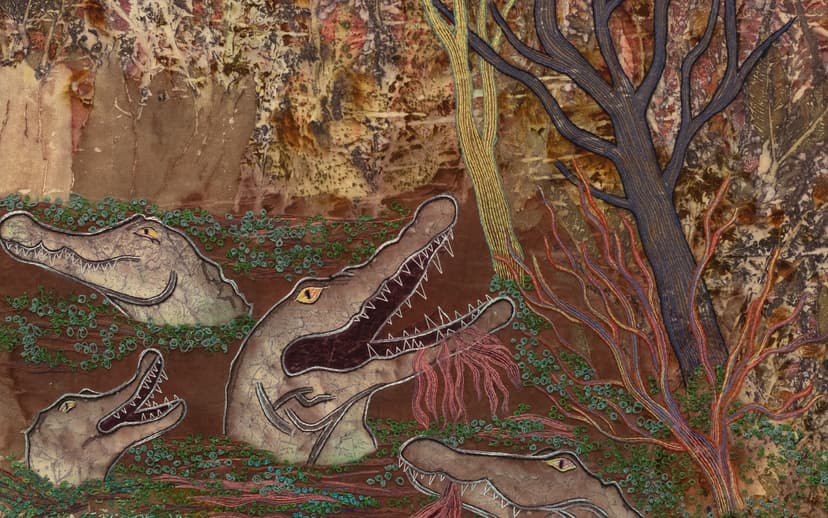
Over the last four years, eco-printing has been so consuming a medium or process that she has had no time to paint. This is only the second major exhibition in which she has not included paintings. For the time being, eco-printing and embroidery are her ways of picture-making. Eco-printing means to press the sap or pigment of leaves, roots, flowers, and bark into paper or fabric. It is a form of mono-printing. Should you google “artists who use eco-printing,” you find people more associated with craft than art. I mentioned the names of these artists to her: she had never heard of them. She learnt to use eco-printing by trial and error – lots of experiments to find which plants would print, and with mordants to make each mark permanent.
I enjoy making my art, Javier tells us; working with plants and a community makes me feel part of the world. I hope the audience will empathise with me and my delight in nature and share my concern at the damage it, and we, are suffering. It is very important to me that this work is very handmade and made with natural materials. It is important to show that things like this can only be made by hand.
Employing and supporting those people who live in her compound or the local barangay and who embroider (ten on this project), garden, or otherwise make the work possible is important to her. Collaborating with the fashion designer Steffi Cua (Javier supplies fabrics, Cua turns them into clothes) has also been fruitful, bringing her ideas to another audience and allowing more experimentation.
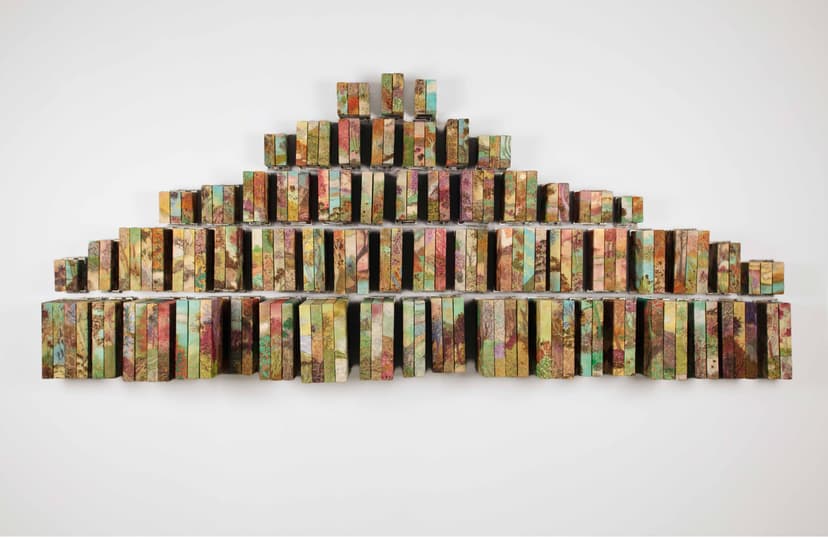
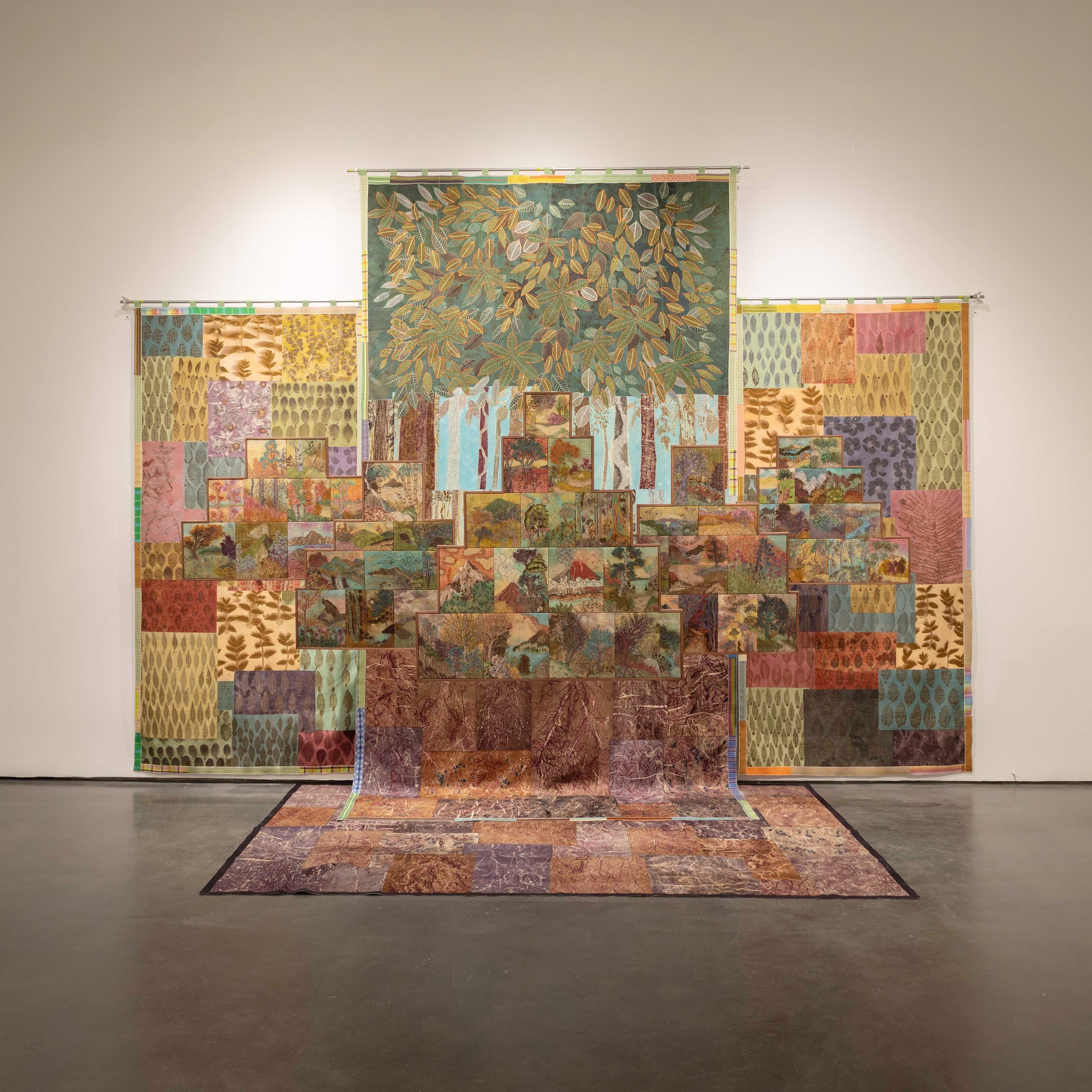
Geraldine and her assistant Jhoven begin the small panels that make up Mount Banahaw and the five ziggurats that hang in front of 7,641 islands by extemporising with eco-printing. On the resulting fabrics, she stitches by hand the outlines of what needs to be stitched by her embroiderers. Her process in making these small fabric works is not dissimilar to the way the mature J.M.W. Turner made watercolours, a colour beginning followed up by detailed work with pencil or small brushes. Only Geraldine uses not graphite or a small brush, but a needle and thread.
The titles of this show and the larger works show the context in which they were made. “State of the Nations”: as in the USA, the President of the Philippines is expected to give an annual address. Please note the final “s”: the problems afflicting the Philippines affect other nations. But her concern is the 7,641 islands of the land she lives in - the nation that, as Maria Ressa has emphasised, is the canary in the mine - the country most vulnerable to climate disasters and the country possibly most vulnerable to social media misinformation.
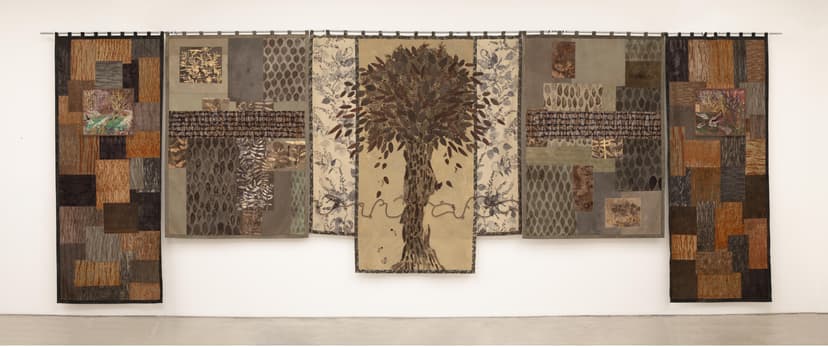
The rusty configurations that are hung across the two largest polyptych tapestries spell out in Baybayin writing the Tagalog sentences: “Bakit tayo mahirap?” and “Kung bakit tayo mahirap.” In English, “Why are we poor?” and “Why we are poor”. Baybayin was the script used to write Tagalog and other languages of the northern Philippines. A script lost, like many other cultural artefacts during the colonial rule of the Spanish.
These two sentences derive from a 2005 essay “Why we are poor” by the late Filipino novelist F. Sionil José. Sionil José laments, as many Filipino intellectuals have, that though in the Fifties and Sixties the Philippines had been the most advanced country in the region, it had long been outstripped not just by South Korea, Taiwan, or Singapore but by Malaysia and Thailand. What had gone wrong? “Why did we not modernize fast enough and therefore doomed our people to poverty?” he asked. The main reasons he gives are,
1. “Our tremendous population increase eats up all our economic gains.” 2. From Spain, “we inherited a social system and an elite that on purpose exploited the masses. We are now a colony of our own elite.” 3. “We are poor because our people are lazy.” (Shades of J.D. Vance here!) 4. “We are poor because we have lost our ethical moorings. We condone cronyism and corruption.”
I asked Geraldine if she agreed with his analysis. She strongly disputed the accusation of laziness: for her, the overriding issue is corruption. She cited the recent scandals about money siphoned off from flood control projects involving senators and congressmen. But, she says, the problem is that corruption runs from top to bottom, as entangled and widespread as mycelium, or the root structures in her polyptych Why are we poor?
She is no social realist shouting out her message: these two polyptychs are beautiful but elegiac, rich but sombre – not unlike the Brahms Deutsche Requiem. Indeed, it is hard not to see the tree at the centre of each as a crucifix. They were made during the dry season when the leaves dry and fall from the trees, making a carpet of browns and greys below.
If the two largest polyptychs are beautiful but funereal, the one hung between them (7,641 islands) resonates with colour, vivacity, diversity and above all, light. If she is angered or dismayed by the nations’ corruption and the climate crisis, she finds hope here. Nature is a cornucopia. Its fecundity is paralleled here by all the elements locked up and only partly visible in her piece Mt. Banahaw. As in other parts of South-east Asia, the belief in the sacredness of mountains has survived the irruption of Islam and Christianity. Mt. Banahaw is especially revered. She finds hope also when she sees people and communities working with nature, setting up community kitchens, growing organic vegetables, working for democracy, making things by hand, caring for others. As Rebecca Solnit recently suggested, “Maybe changing the world is more like caregiving than it is like war.” It used to seem an oddity that she had studied nursing before training as an artist, but now we can see that the ethos of a nurse may have similarities with that of an artist farmer.
A more extended examination of recent works by Geraldine Javier, written by this author, may be found in Issue Magazine No. 15. Tony Godfrey has written extensively about Contemporary Art since 1978. His most recent book was The Story of Contemporary Art Thames and Hudson/MIT) He has also worked as a teacher (the initiator, with Anna Moszynska, of the Sotheby’s MA in Contemporary Art) and curator. Around 2010, he moved from Britain to South-East Asia. He now lives in the Philippines.