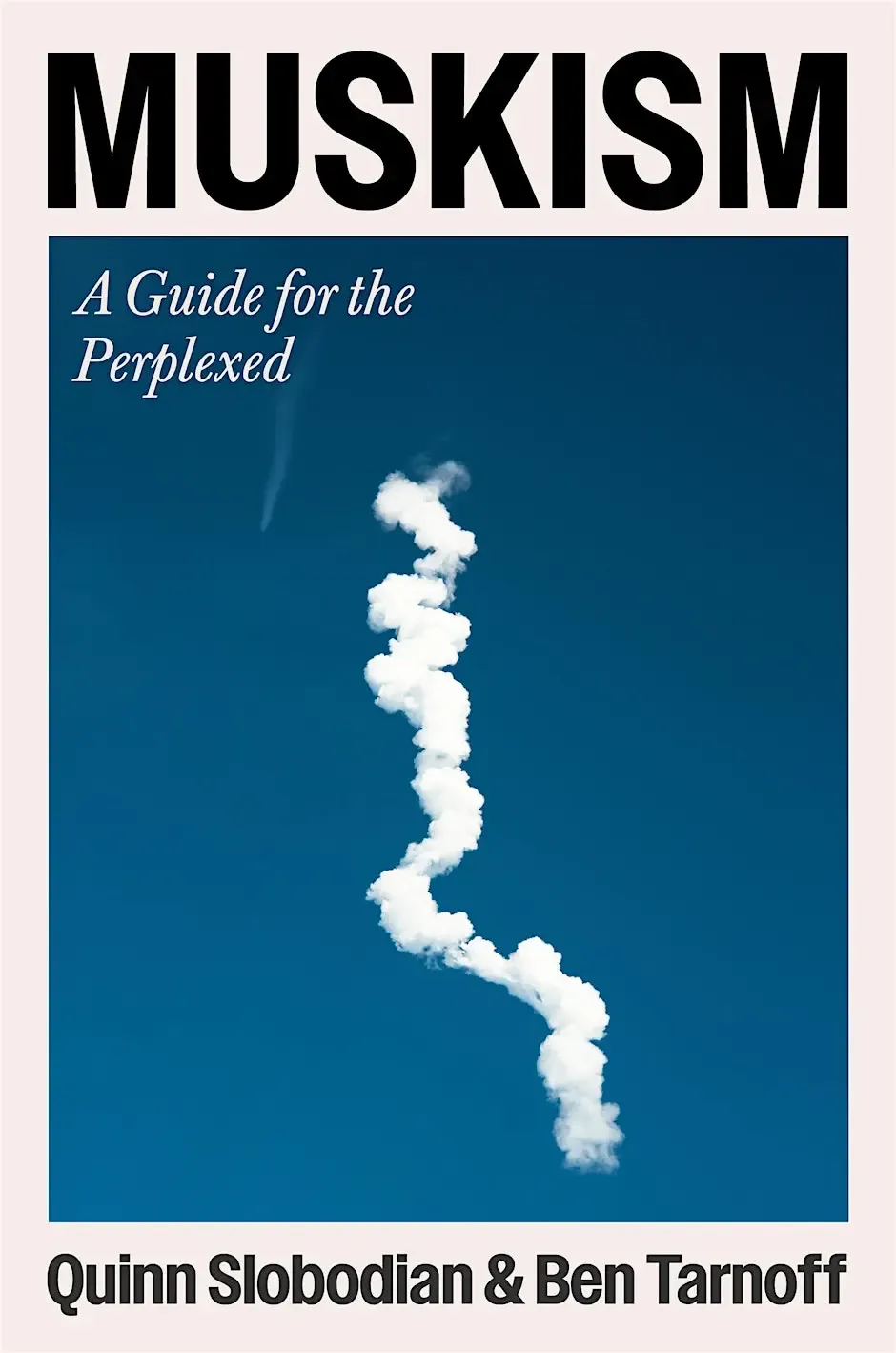
Elon Musk. A troubled dreamer. A power-hungry, vengeful bungler. A hero who became a villain; a villain who became a hero.
In conjunction with the launch of MUSKISM: A Guide to the Perplexed, please join us for a conversation between Quinn Slobodian and Ben Tarnoff, moderated by Joshua Citarella.
Elon Musk. A troubled dreamer. A power-hungry, vengeful bungler. A hero who became a villain; a villain who became a hero. What if he isn’t any of these things? What if he was more like, an idea? An avatar for a world view, the master code for an operating system. It’s one that Quinn Slobodian and Ben Tarnoff are calling MUSKISM: A Guide to the Perplexed.
To understand Elon Musk and the world he intends to make, we have to understand the worlds that made him. From his early years in apartheid South Africa come a deep commitment to racial hierarchy, industrial self-reliance, and fortress futurism. From Silicon Valley we get the idea to finance moonshot projects with public money. And online we see Musk use the tools of virality, repetition and provocation to undermine legacy institutions in pursuit of a kind of techno-state. Not dissimilar to the world of his beloved video games.
Why do we care? Because the worlds that made Musk are now making ours. Into a de-globalizing world comes a promise of sovereignty through technology. But not for everyone: which is an appealing pitch in our era of anti-humanitarianism. The techno-maximalism of the political and business elite sees a cyborg future and signs us all up.
To say that Muskism is worth taking seriously is not to say that its success is guaranteed. But the institutional breakdown of our era offers an opening. At some point, society will stabilize on a new basis. Muskism could provide the foundation. We think it best to try to understand the ground beneath us.